A Movement Break Between Screen Tasks
A movement break between screen tasks can make the shift from one seated job to the next feel less abrupt, without turning the pause into a workout.
How do you fit a movement break between screen tasks without turning it into another assignment? A movement break between screen tasks works best as a transition cue: a small, comfortable pause that marks the end of one seated task and the start of another. The point is not to hit a target. It is to give your body a change of position before your attention settles into the next stretch of sitting.
A task boundary makes a natural cue
Imagine Maya, an invented remote worker who spends her morning moving from a spreadsheet to email, then from email to a video call. She notices that she often begins the next task while still in the same position, shoulders rounded toward her laptop and feet tucked under her chair. She wants a pause that fits the shape of her workday, not a workout she has to schedule and complete.
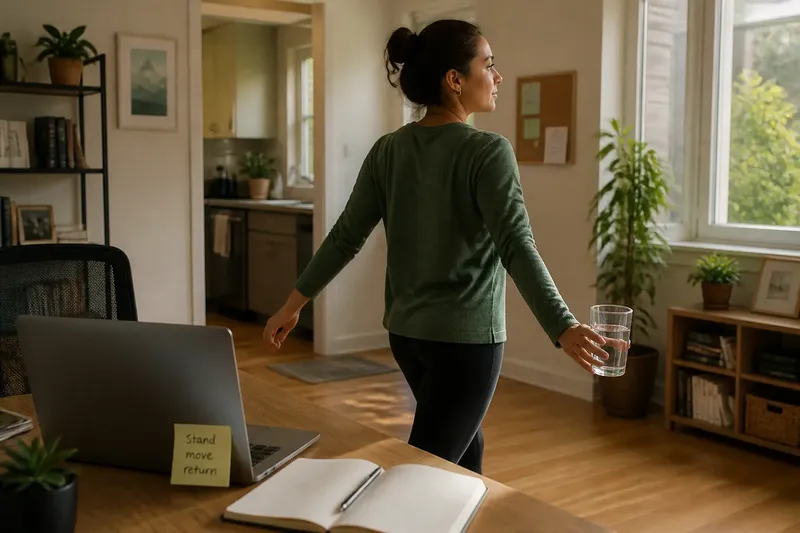
Maya chooses one cue she can already see: finishing a substantial task and closing its document. That boundary is more dependable for her than a clock reminder, because meetings and focused work do not always follow the same rhythm. She places a small note beside her trackpad that says “stand, move, return.” It is a prompt, not a scorecard.
A useful cue is specific enough to notice and easy to repeat. It might be sending a finished draft, leaving a call, or switching from a design file to a message inbox. Pick a transition that happens naturally in your own day, rather than adding a new alert that competes with the work.
Start by choosing one recurring task boundary, not every change in every app.
One comfortable pause can have a simple shape
At the first boundary, Maya pushes her chair back, stands, and walks to the kitchen to refill her water glass. On the way, she lets her arms hang loosely and takes a few easy steps around the room. She returns, sets the glass down, and begins email. Nothing is timed, counted, or judged.
The sequence is short because it uses an ordinary destination and familiar movements. It also gives her a clear ending: she comes back to her desk and starts the next task. A pause does not need a special routine, a mat, or a change of clothes to feel distinct from sitting.
If getting up is awkward in your space, change the movement to suit it. You might shift your feet, gently turn your upper body within a comfortable range, or stand beside the chair if that feels steady. Keep the motion easy, and stop or adjust if it causes pain, dizziness, or unusual discomfort.
- Stand and walk to a nearby window, doorway, or water source.
- Take a few unhurried steps while letting your arms move naturally.
- Reach comfortably overhead or out to the sides, without forcing the range.
- Shift your weight from one foot to the other while standing near a stable surface.
- Return to the desk when the pause feels complete, rather than waiting for a target.
Choose one or two movements that feel pleasant and practical in your room. A long menu can make a small pause feel like a decision-heavy routine.
The plan should bend around the workday
After a few transitions, Maya reaches a run of meetings. She cannot comfortably leave the room during one call, so she changes the cue: when the call ends, she stands before opening the next document. During a later block of focused work, she stays seated until she reaches a genuine stopping point. Her plan makes room for the job instead of treating every screen change as a command to move.
This flexibility matters because a useful habit is not a rigid rule. A transition cue can mean a walk on one occasion and a brief change of posture on another. If the day is crowded, a small shift still marks the boundary; if the day is open, a short walk may feel welcome.
Keep the pause separate from the work target. Do not make yourself earn a break by finishing an arbitrary amount, and do not judge the pause by how much effort it takes. The cue is simply a reminder that one task has ended and another is beginning.
When a transition is too busy, carry the cue forward to the next realistic boundary.
Small adjustments can keep the habit comfortable
On another day, Maya notices that the kitchen route is blocked by a delivery box. Rather than abandon the pause, she takes a few steps to the doorway and back. Later, she realizes that a water refill is not convenient during a meeting-heavy morning, so she keeps the same cue and chooses a standing posture change near her desk instead.
That is the useful lesson from her invented situation: preserve the transition, not the exact movement. A cue that depends on a clear hallway, a particular drink, or a perfect stretch of free time can become fragile. A cue paired with several comfortable options can survive an ordinary change of plans.
Make the immediate surroundings easy to use. Push the chair back far enough to stand without bumping into a drawer, keep a clear path if you plan to walk, and leave shoes or other gear out of the decision unless your movement actually requires them. For a simple indoor pause, ordinary clothes and a few steps are usually enough.
If standing or walking is not comfortable or accessible for you, choose a seated movement or another change of position that suits your needs. For personal guidance about movement, pain, or a health condition, ask a qualified health professional.
What readers ask about movement breaks?
How long should a movement break between screen tasks be?
There is no required duration for this kind of pause. Let the transition determine its shape: a brief posture change may be enough, while a walk to another room can take a little longer.
Do I need a timer to remember the pause?
Not if a recurring task boundary is easier to notice. A timer can help if your work has few natural transitions, but it should remain a reminder rather than a demand to interrupt something that cannot pause.
Does a movement break need to feel like exercise?
No. The aim here is to change position and create a comfortable break between seated tasks, not to build a training session into the workday. Easy walking or a gentle shift of posture can serve that purpose.
What if I miss the cue?
Use the next suitable transition rather than trying to make up for the missed pause. The habit is tied to a normal boundary in the day, so one missed opportunity does not need a penalty or a catch-up routine.
Notice whether the transition feels useful
By the end of Maya’s invented workday, the result is modest and observable: she has used task endings as reminders to change position, and she has adjusted the movement when her room or schedule called for it. That does not prove the plan will suit everyone. It shows how a low-pressure cue can fit into a particular day without becoming another performance measure.
For a few workdays, notice whether the cue is easy to spot and whether the chosen pause feels comfortable. If it keeps interrupting important work, move it to a clearer boundary; if the movement feels awkward, swap it for a simpler one. A movement break between screen tasks is most useful when it makes the handoff between jobs feel intentional, then lets you return to the next task without fuss.