The Full-Kit Fallacy: Name the Job First
A job-first equipment checklist helps you start a new activity with what its first sessions actually require, leaving tempting extras for later.
What equipment do you actually need to begin a new activity? A job-first equipment checklist starts with the task in front of you, not a picture of a perfectly equipped athlete. That distinction can keep a promising new routine from turning into a shopping project.
Full kits are easy to imagine: matching clothes, specialized accessories and a bag with a place for everything. But the first session usually asks for a short list of practical jobs—move comfortably, use the space safely, carry what you need and follow the activity’s basic rules. Name those jobs before you decide what to buy.
Start with the first session, not the ideal setup
Write down what you expect to do at your first few sessions. Be specific about the activity and setting: a beginner swim at a public pool, a walk on paved paths, a casual badminton game in a recreation center or a basic strength session at a gym. “Get fit” is too broad to guide an equipment choice.
Then describe the session in plain language. For a pool visit, that might mean swimming laps, changing afterward and carrying wet items home. For a gym visit, it might mean using equipment already there, following posted instructions and bringing a way to store personal belongings.
This small change in framing catches a common mismatch. A trail-running vest may look useful, but it does not address the immediate needs of a beginner who plans to walk on familiar local paths. The first session, not a future identity, is the unit you are equipping.
Turn each task into an equipment job
List the jobs your equipment must do. Keep the wording functional: provide a suitable surface for movement, meet an access rule, hold personal items, keep a change of clothes separate, or support a comfortable grip. A product earns consideration only if it answers one of these needs.
For each job, ask whether an item is required, already available, borrowable or optional. “Already available” can include equipment supplied by a facility, basic items in your home or something a friend can lend. Do not assume that a purchase is necessary just because a product is commonly shown alongside the activity.
Use these questions as a working checklist:
- What will I physically do? Match equipment to the movements and surface in the planned session.
- What must I bring to enter or participate? Check facility or event rules, including any required clothing or personal items.
- What is already supplied? Ask the venue what it provides and what participants must bring themselves.
- What needs to stay dry, clean or contained? Consider a simple bag or separate pouch only if the session creates that need.
- Can I borrow or use a basic substitute? A short trial may call for a temporary option rather than a specialized purchase.
- What would make the activity uncomfortable or impractical? Identify the specific problem before looking for a product that claims to solve it.
- What can wait until I have experience? Set aside upgrades whose usefulness depends on a preference or habit you have not yet developed.
For each line, write a decision beside it: bring, borrow, confirm with the venue, buy, or defer. The decision is more useful than a long catalogue of possible gear.
Separate requirements from conveniences
Required equipment is an item the activity cannot reasonably proceed without, or that a venue or organizer says participants must have. A swimsuit may be required for a pool; a racket may be necessary for a particular game if none is supplied. These are concrete constraints, not assumptions about what an experienced participant owns.
A convenience makes a session easier without defining whether you can take part. A dedicated shoe bag, an extra towel or a specially designed bottle holder might be handy, but the job may already be covered by something you own. Convenience is personal: a long commute with wet swimwear creates a different packing problem from a quick walk home.
Optional extras are items that may suit a later preference, setting or level of participation. A wearable tracker, spare training top or advanced accessory can wait until you know what you want it to do. “Optional” does not mean useless; it means the first session does not depend on it.
Check what the setting supplies
Before buying equipment, check the facility page, event information or organizer’s instructions. Look for details about loan equipment, changing areas, storage, clothing rules and whether participants need to bring their own supplies. If a detail is unclear, ask the staff or organizer rather than guessing from product lists or social-media photos.
For equipment that directly affects health or safety, follow the manufacturer’s directions and the relevant facility or activity rules. A qualified instructor or other appropriate professional can help when an item needs to fit your body, ability or circumstances; do not improvise with equipment whose suitability is uncertain.
Keep this check focused. You are not trying to research every possible accessory. You are resolving the few questions that could prevent participation or make the planned session unsuitable.
Choose the simplest suitable option
Once the jobs and requirements are clear, compare the options that meet them. Start with items you already own or can borrow, then consider a basic purchase if there is still a real gap. Pay attention to fit, condition, compatibility with the activity and the ease of cleaning or carrying the item.
For footwear, for example, the relevant questions depend on the surface and movement planned. A casual paved walk and an indoor court activity ask for different qualities; a shoe that feels fine for one setting may be a poor match for another. If you are unsure, seek advice from a qualified professional who understands the activity and your needs.
Resist buying a bundle simply because its contents are packaged together. A bundle can include useful items, but its completeness is not evidence that each piece serves your first-session jobs. Check every component against your list, and set aside anything without a clear purpose.
Try the plan on paper before you pack
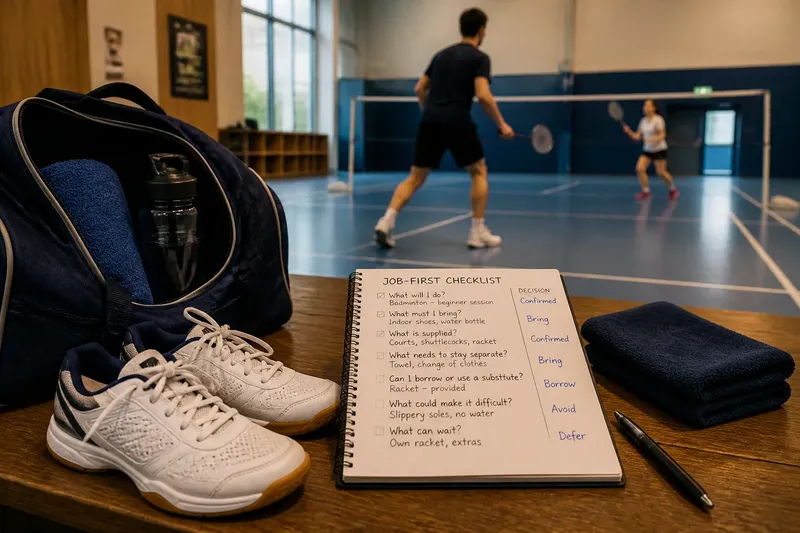
Imagine you are joining a beginner badminton session at a recreation center. The organizer says courts and shuttlecocks are provided, but participants need suitable indoor footwear and a water bottle. Your job list now has a clear starting point: confirm footwear, bring a bottle and leave the racket purchase for later because the venue supplies one.
The expected observable result is straightforward: you arrive with the stated essentials and can take part without carrying an unused racket or a bundle of extras. If the organizer later says loan rackets are unavailable, the list changes in response to a real requirement, not an imagined one.
Try the same paper check for your own activity. Follow the session from arrival to departure: what goes on your body, what you use, what you carry, and what must come home damp, dirty or separate? A simple note on your phone is enough; no elaborate inventory is needed.
Review after the session, then add selectively
After the first session, note what you actually used and what felt missing. Separate a genuine obstacle from a passing preference. If you had nowhere to keep a locker key, that is a practical gap; if a specialty accessory merely looked appealing, give yourself time to decide whether it solves a recurring problem.
Make changes one job at a time. If carrying wet swimwear is awkward, choose a way to contain it. If a class requires a particular item, confirm the requirement and select something suitable. A small adjustment is easier to judge than a full kit bought in anticipation.
For recurring activities, repeat the review after your routine changes. A new venue, surface, session format or travel pattern can create a genuine equipment need. The purpose is not to keep the kit permanently minimal; it is to let your actual activity—not a catalogue’s idea of completeness—set its shape.
What should you bring when the rules are unclear?
Should beginners buy a complete equipment set?
Usually, begin with the items required for the first session and defer extras until you know what the activity involves. A set can make sense when every included item meets a clear need, but a bundle alone is not a reason to buy.
Is borrowing equipment a sensible way to start?
Borrowing can help you find out whether a basic item suits the activity before you choose your own. Confirm that the item is appropriate for the session and in usable condition, and follow the owner’s or venue’s instructions.
What if the venue does not say what it provides?
Ask the facility or organizer directly about the items that determine whether you can participate. If you cannot confirm a detail in time, choose a practical fallback only when it is suitable for the activity rather than packing a stack of speculative extras.
When is specialized equipment worth considering?
Consider it when repeated sessions reveal a specific need, or when an instructor, venue rule or manufacturer guidance calls for it. Match the item to that need and your circumstances, and seek qualified advice if fit or safe use is uncertain.
A job-first equipment checklist is not a rule against owning useful gear. It is a way to make each item explain its place: what it helps you do, what requirement it meets, or what real inconvenience it addresses. Name the job first, then let the kit grow only when the activity gives you a reason.